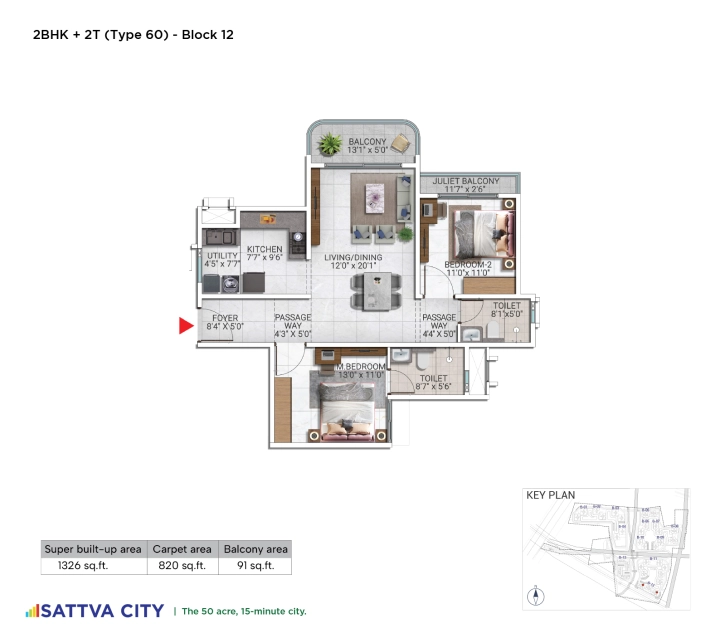
2 BHK
1306 to 1352 sq ft. Indicative launch price from Rs 1.82 crore.
Floor Plans
The floor plan spread is one of the strongest parts of the launch. It gives the project reach across budget bands while still preserving premium formats at the upper end.
1306 to 1352 sq ft. Indicative launch price from Rs 1.82 crore.
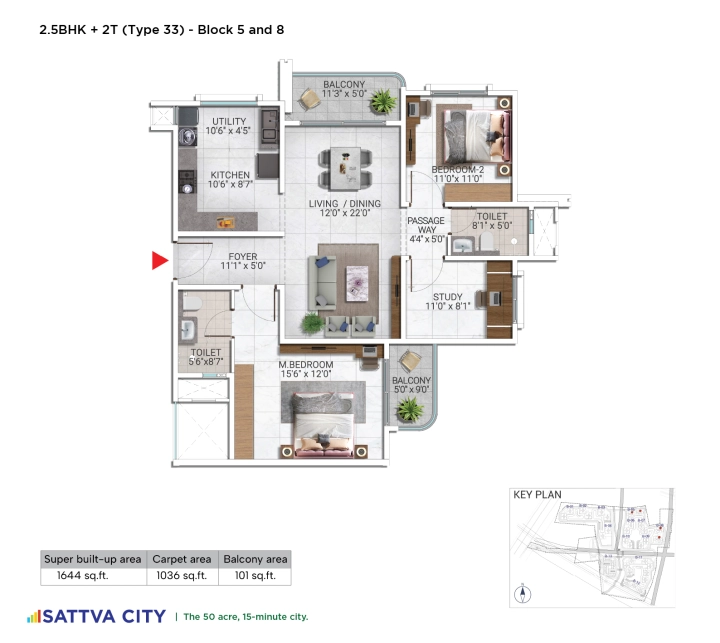
1644 to 1699 sq ft. A practical upgrade for families wanting a study or flexible room.
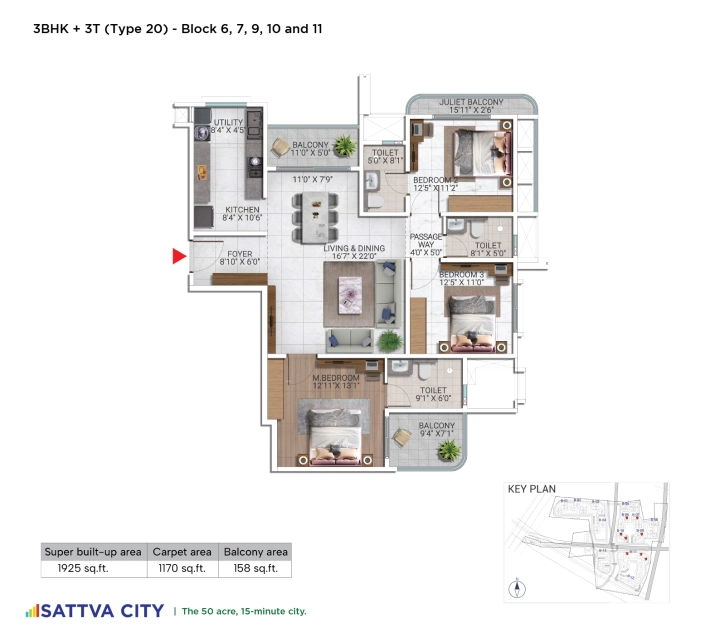
1925 to 2003 sq ft. Strong fit for long-term family users in the township.
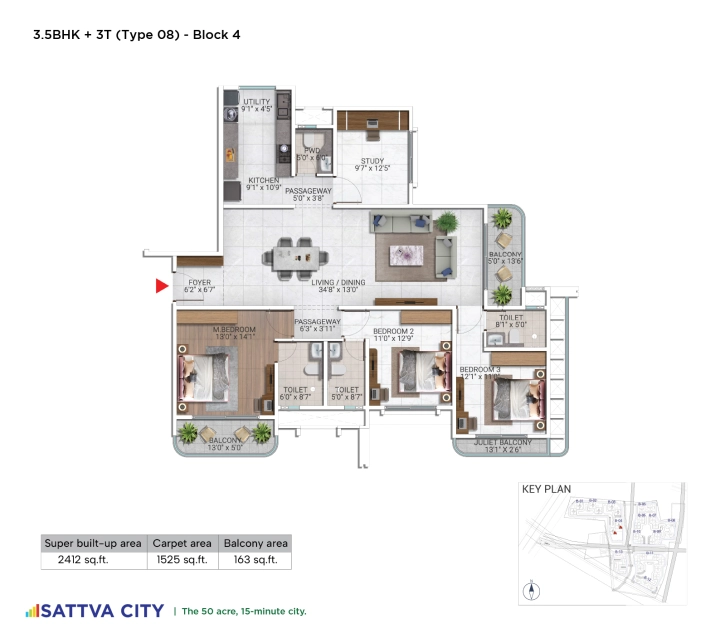
2244 to 2412 sq ft. Premium family upgrade with stronger zoning and room count.
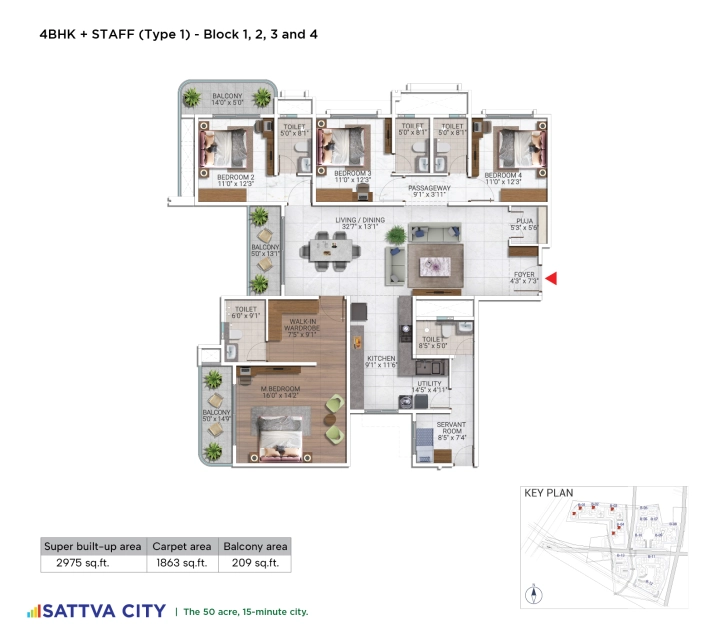
2711 to 2975 sq ft. Large-format luxury inventory inside the township mix.
Penthouses are presented in the 6266 to 7174 sq ft band, with pricing from about Rs 9.3 crore to Rs 9.6 crore depending on layout and tower context.
Floor Plan Reading
A brochure can charm you with words. A gallery can impress you with pictures. But it is the floor plan that quietly tells you the truth.
A floor plan is the drawing that shows how a home really works, how rooms connect, how wide the living room feels, how much wall you have for cupboards, and how the balcony sits against the kitchen or bedroom. If you learn to read it well, you stop buying an idea and start buying a space that will actually fit your life. The official Sattva floor plan pages are a useful reference point here.
The official Sattva City floor-plan pages describe a floor plan as a 2D top view of the home, showing how each room connects with the others, where doors and windows sit, and how space flows from one area to the next. It is not just a sketch. It is the blueprint of your daily routine.
Good floor plan guides repeat the same idea: the key things to look for are scale, room sizes, orientation, and flow. You want to know whether rooms get natural light, whether you can walk from kitchen to dining to balcony without awkward corners, whether there is a quiet corner for work or study, and whether bedrooms give you privacy from the living room.
If you want a simple refresher on floor plan reading, guides like RoomSketcher’s floor plan guide explain the basics clearly. You do not need to become an architect. You just need to learn to see beyond pretty furniture and focus on the lines and numbers.
Sattva City is a big township. It has 13 towers and around 3,460 apartments in 2, 2.5, 3, 3.5, and 4 BHK configurations. That much choice is good, but it also means you need a clear way to compare options. The project sits across 50 acres, and the floor plans are spread across a wide size range.
The core launch focus is on 2 BHK and above. Some earlier marketing material shows broader unit types, but the current page structure is really about practical family homes, flexible upgrade homes, and premium larger formats.
The 2 BHKs are the entry point into Sattva City for most end users. Typical 2 BHK units are around 1,306 to 1,352 sq. ft. of saleable area. Different stacks offer slightly different numbers, but the exact square feet matters less than how those square feet are used.
A standard 2 BHK layout here usually includes a living and dining zone opening to a balcony, a kitchen with attached utility, two bedrooms, and one or two bathrooms depending on the stack. For a couple or a small family, this is often enough. If you both work and have one child, a 2 BHK where bedrooms are tucked away from the main door and living room can feel comfortable for many years.
A 2.5 BHK is really a 2 BHK with an extra room that can become a study, a child’s bedroom, or a small guest room. It is one of the most practical layouts for urban families today. In Sattva City, 2.5 BHK units often sit around 1,580 to 1,699 sq. ft., with multiple sub-variants across the stack mix.
This configuration works well if you have one child now, one of you works from home, or you want a reading room or kids’ playroom without pushing the budget all the way to a 3 BHK. Because 2.5 BHKs sit between 2 and 3 BHKs in both size and price, they can be a good compromise if you want more utility but still want to keep your EMI in check.
For many buyers in a large township like Sattva City, the real decision is between 3 BHK and 3.5 BHK. The 3 BHK homes here start from around 1,812 sq. ft. and go up to just under 2,000+ sq. ft., depending on the exact stack. These are full-fledged family homes with three bedrooms, three toilets, a generous living and dining space, and kitchen plus utility.
The 3.5 BHK floor plans stretch this idea further. Sizes here move into the 2,200+ sq. ft. band. The extra half room is more than a study; it can be a small fourth bedroom, a media room, or a full-time home office. If you have two children, occasional or permanent live-in help, or parents living with you, 3.5 BHK gives you breathing room that a standard 3 BHK may not.
At the top of the regular range sit the 4 BHK + staff units. These homes are for larger or multi-generation families, or for buyers stepping up from an independent house who do not want to downgrade on space. The presence of a staff room and additional service spaces makes daily life with help smoother and more private.
Sattva City offers 4 BHK + staff layouts around the premium end of the mix, with large living and dining zones, a bigger kitchen with utility, multiple balconies, and a separate staff room with toilet.
You do not need to memorise every number on the floor-plan grid. What you need is a simple way to compare options. Look at entry and privacy. Follow light and air. Check usable walls. Count circulation, not just rooms. Then map the layout to your daily routine.
If you want a broader reference on how floor plans are used in real estate, a government-linked or official project document is always better than a random blog. You can also verify the project registration details on Karnataka RERA when you want to cross-check the project basics.
A floor plan never sits alone. It always lives inside a tower, inside a master plan, inside a city. Once you like a particular layout, check where it sits in the master plan using the master plan page, then check how size and stack affect cost on the price page.
That is the triangle you want to balance: layout, location, and budget. Walk through the drawings slowly. Measure them against your daily life, not just your wishlist. A good floor plan is not the most dramatic one; it is the one that will quietly work for you, every day, for many years.
Need unit-level help?